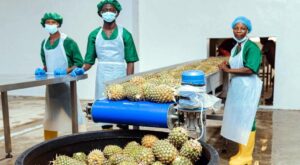

At a recent family gathering, a young man announced that he was leaving his bank job to farm pineapples full-time. There was a brief silence, followed by laughter……………. Then came the inevitable question from the uncle who always has an opinion on everything:
“So na pineapple go make you rich?”
It is a fair question. Pineapple has become one of the crops most frequently associated with agricultural opportunity in Nigeria. It appears in profitable-crop lists, dominates many agricultural conversations, and is often linked to stories of farmers who have done exceptionally well.
But there is a significant difference between hearing that a crop is profitable and seeing a return on your own investment. The real question is not simply, “Does pineapple pay?”
It is: If I invest my money, will I get it back, and when?
That question deserves more than motivation or social-media hype. It deserves an honest look at the numbers, the risks, and the work required to achieve a profitable harvest.
Why many people never get started
Pineapple farming can generate strong returns, but the path to those returns is demanding. Before the first fruit is harvested, a farmer must clear and prepare the land, source tens of thousands of planting suckers, hire and supervise labour, manage weeds, apply the right inputs, and monitor the crop throughout its development.
The quality of planting material matters. Soil condition matters. Timing and field supervision matter. So do rainfall, pest pressure, harvest conditions, and the price available when the crop reaches the market.
Most importantly, the first harvest typically takes 12 to 18 months. During that period, there may be no income from the crop, yet the farmer remains responsible for every cost and every operational decision. Even after a successful harvest, selling at a profitable price requires market knowledge, buyer relationships, volume, and negotiating power.
This is the part that short videos and success stories often leave out. The crop may be profitable, but managing the entire production cycle alone can be stressful, time-consuming, and expensive. For many aspiring farmers, the challenge is not a lack of interest. It is the burden of carrying every stage of the process without the benefit of scale or specialist support.
A different way to participate – own the harvest, not the headache
At Davidorlah’s, we have seen what creates stress in pineapple farming. It is not the crop itself. It is trying to manage land preparation, planting materials, labour, inputs, supervision, harvesting, and sales independently.
That is why we created opportunity to be a farmer without going to the farm.
Through the partnership, individuals own a plot within Davidorlah’s pineapple estate for ₦3,000,000 per plot. The estate’s field team manages the production cycle on the owner’s behalf. This includes soil testing, planting and spacing, input scheduling, weed control, field supervision, harvest logistics, and market coordination.
The owner provides the capital. Davidorlah’s provides the operational expertise and oversight required throughout the 65 months cycle. Owners are targeting an annual return of 36% on their investment, while the estate team handles the day-to-day work of producing and marketing the crop.
The model is designed for people who want exposure to agricultural opportunity without leaving their careers or personally managing farm operations. The question is simple: is your time better spent supervising labourers and chasing buyers, or allowing a team that performs this work daily and at scale to manage the process for you?
Why scale and professional management matter
A smallholder farmer purchasing planting suckers independently may pay retail prices and receive inconsistent quality. A managed estate can purchase at scale and apply uniform standards across its plots. That creates greater consistency from planting through harvest.
The same principle applies to field management. An individual farmer may rely on guesswork or learn through trial and error. A professionally managed estate can base its input programme on soil testing, established schedules, and continuous field supervision. Weeding, nutrition, and crop maintenance become planned activities rather than occasional responses to visible problems.
Marketing is equally important. A farmer selling a small harvest at the farm gate may have little choice but to accept the price offered that day. An estate producing at volume has stronger buyer relationships, greater bargaining power, and a more coordinated route to market.
Professional management does not remove the 12-to-18-month growing period. It changes who carries the operational responsibility during that period. The owners remain focused on ownership and returns while the estate team handles the work required to achieve them.
So, can pineapple farming really make you rich?
The honest answer is that pineapple does not create wealth by accident. Strong returns depend on several factors working together: properly costed land, quality planting material, disciplined input application, effective supervision, and intelligent marketing.
The economics can support attractive returns in Ogun State, but most individual farmers struggle to manage all these requirements consistently without the process consuming their time and attention.
That is the gap Davidorlah’s estate partnership is designed to address. You provide the capital; we provide the land-based operations, field supervision, production discipline, and market coordination. With an investment of ₦3,000,000 per plot, you are positioned for a targeted annual return of 35% while our team manages the farming process.
So perhaps the best answer to that uncle is not simply “yes” or “no.” It is this:
Pineapple can pay and you do not have to farm it yourself to participate in the opportunity.
If ₦3,000,000 could be working for you at a targeted 36% rental income without requiring you to leave your work or manage a farm personally, would you rather do the farming or own the outcome?